

Contact

Production Tool

CueCheck

Prove that the correct version of every piece of content reached every playback machine that needs it — before the show finds out for you.

In Development

  • Local and LAN workflow
  • Watch · validate · stage · deliver
  • Media probe validation
  • Production-network dashboard
CueCheck — Show Rules / Organization
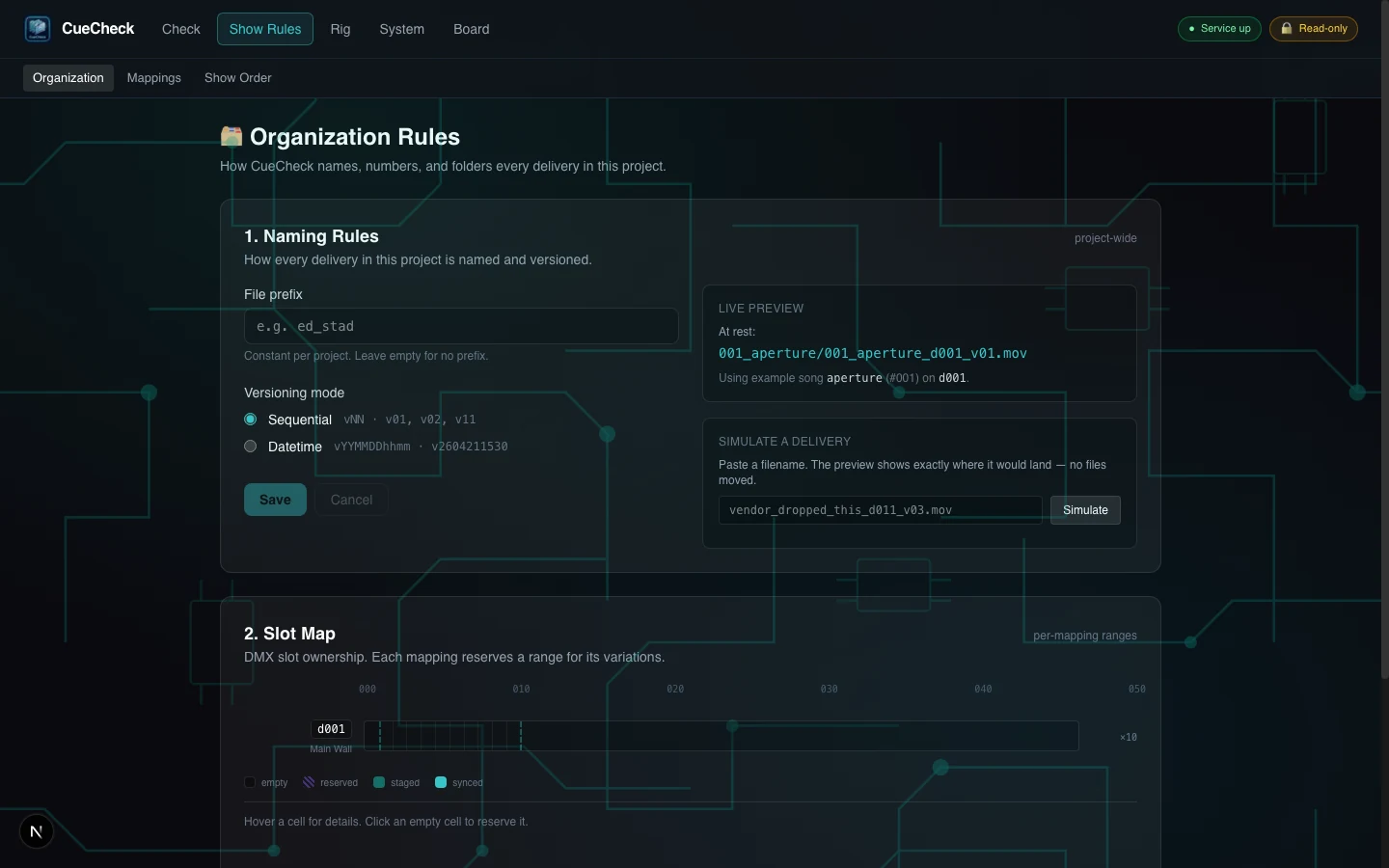
The CueCheck Organization Rules screen: a naming-rules panel with file prefix and versioning-mode controls, a live preview of the resulting path, a simulate-a-delivery box, and a slot map showing reserved delivery ranges.

Organization rules — naming, versioning and slot ownership in one place. Current CueCheck dashboard connected to its real service and a throwaway acceptance database. Read-only state; no production path, rack hostname, network address, machine inventory, artist or show name. Every detail on this page is a region of this same frame.

02

The rules, before the panic

Decide how content is named while nobody is shouting

Naming, versioning and slot ownership are settled as project rules, and the application shows you the exact result of those rules before a single file arrives.

Job — keep names honest

One convention, stated once, applied to everything

A project sets its file prefix and its versioning mode, and every delivery in that project inherits them. Consistent naming is what makes the rest of the pipeline — and the console — predictable.

  • Automatic renaming to the show's convention with prefix enforcement
  • Sequential or date-based versioning, chosen per project
  • Deliverable identifiers that drive routing and visibility
  • Slot ranges, show order and reservations so a slot can be claimed before content arrives

Boundary CueCheck validates and delivers. It does not transcode content into spec on your behalf.
Detail — naming rules
The CueCheck naming rules panel with a file prefix field, a sequential versioning option showing examples such as v01 and v02, a date-time versioning alternative, and save and cancel actions.

Interface detail from the accepted view — the project's file prefix and versioning mode, with the format of each option written next to it.

Job — catch it early

Simulate the delivery before anything moves

Paste a filename a vendor is about to send and the preview shows exactly where it would land under the current rules. Nothing is copied, renamed or moved to answer the question.

  • Live preview of the at-rest path produced by the current rules
  • Simulation from an arbitrary pasted filename, with no files moved
  • Probe-driven checks on resolution, codec, frame rate, colour and file size
  • Rejected and needs-review files are separated rather than silently dropped

Boundary CueCheck is a production-network tool, not a public content-distribution service, and it does not play back or drive a show.

Detail — live preview and simulation
The CueCheck live preview showing the folder and filename a delivery would take at rest under the current rules, beside a simulate-a-delivery box holding a pasted vendor filename and a simulate action, with a note that the preview moves no files.

Interface detail from the accepted view — the resolved at-rest path, and a simulation that states plainly that no files are moved.

03

The safe loop

Validate first, deliver second, swap only when complete

Content that fails the spec never reaches a playback machine, and a destination is only updated once the whole target set is ready — so a half-finished delivery cannot become a half-finished show.

  1. 01

    Watch

    Monitor the delivery folder the content team is already using, without changing how they work.

  2. 02

    Validate

    Probe each file against the spec profile for its destination, and state the reason in plain language when it fails.

  3. 03

    Name and stage

    Apply the show's naming convention and hold the file in a controlled staging area.

  4. 04

    Deliver

    Push to the required destinations over the local network and record what actually landed.

  5. 05

    Swap and report

    Complete the target set, swap atomically, and tell the room what changed.

Built for

  • Video engineers and media server operators receiving content under time pressure
  • Content leads enforcing one spec across several creators
  • Production managers who need delivery status without asking for it
  • Shops running the same validation rules across repeat shows

Outside its authority

  • It validates and delivers — it does not play back or drive a show
  • It does not transcode content into spec on your behalf
  • It does not manage a media server's internal show state
  • It is a production-network tool, not a public content-distribution service

04

Interface detail bench

Ownership and posture, both visible

Both benches below are regions of the same accepted dashboard capture shown at the top of this page. Use Full frame on either one to see where the region sits in the window.

The CueCheck slot map explaining that each mapping reserves a range for its variations, with a numbered slot ruler and a reserved block labelled for a main wall mapping.

A Slots are owned before content exists

Interface detail from the accepted view. A mapping reserves its own range, so a destination's slot can be claimed while the content is still being made rather than fought over on the day.
The top-right corner of the CueCheck dashboard showing a service-up indicator beside a read-only mode chip.

B Service state and write posture

Interface detail from the accepted view. The dashboard reports whether the service is up and whether it may write. This capture was taken in read-only mode, which is why nothing here could have altered a delivery.

These are crops of one real dashboard capture against a throwaway acceptance database, not separate sessions.

05

Availability

In development, not yet quoteable

In Development

CueCheck is not on sale and has no published price.

The product is in active development. Its commercial package — the shape of a founder-guided production pilot, a perpetual operator licence, optional annual updates and short-term rental — is a proposal under review, not an approved offer, so no amount appears on this page.

Earlier tier structures published on this site are retired. There is no public pilot programme to sign up for today.

Platform
Runs on the production network: a validation and delivery service with a browser dashboard.
Dependencies
Media probing relies on standard open media tooling being available on the host.
Data boundary
Content, destinations and credentials stay inside the production's own network and keychain.
Release state
In development. Packaging, licensing and support terms are not published.